Lateral Mixing Coefficients
In this page, you will learn how SURF-NEMO defines the lateral mixing parameters for tracers and momentum, and how these values are automatically estimated at runtime. The automatic estimation is always active in the Base configuration, and is the default behaviour in the Expert configuration whenever custom values are not provided.
Lateral mixing parameterizes the effect of unresolved horizontal turbulent motions on momentum and tracers. In a nested downscaling configuration, this is particularly important because the amount of unresolved variability depends on the horizontal grid resolution. A finer child grid resolves smaller spatial scales than the parent model and therefore generally requires a different level of lateral diffusion and viscosity.
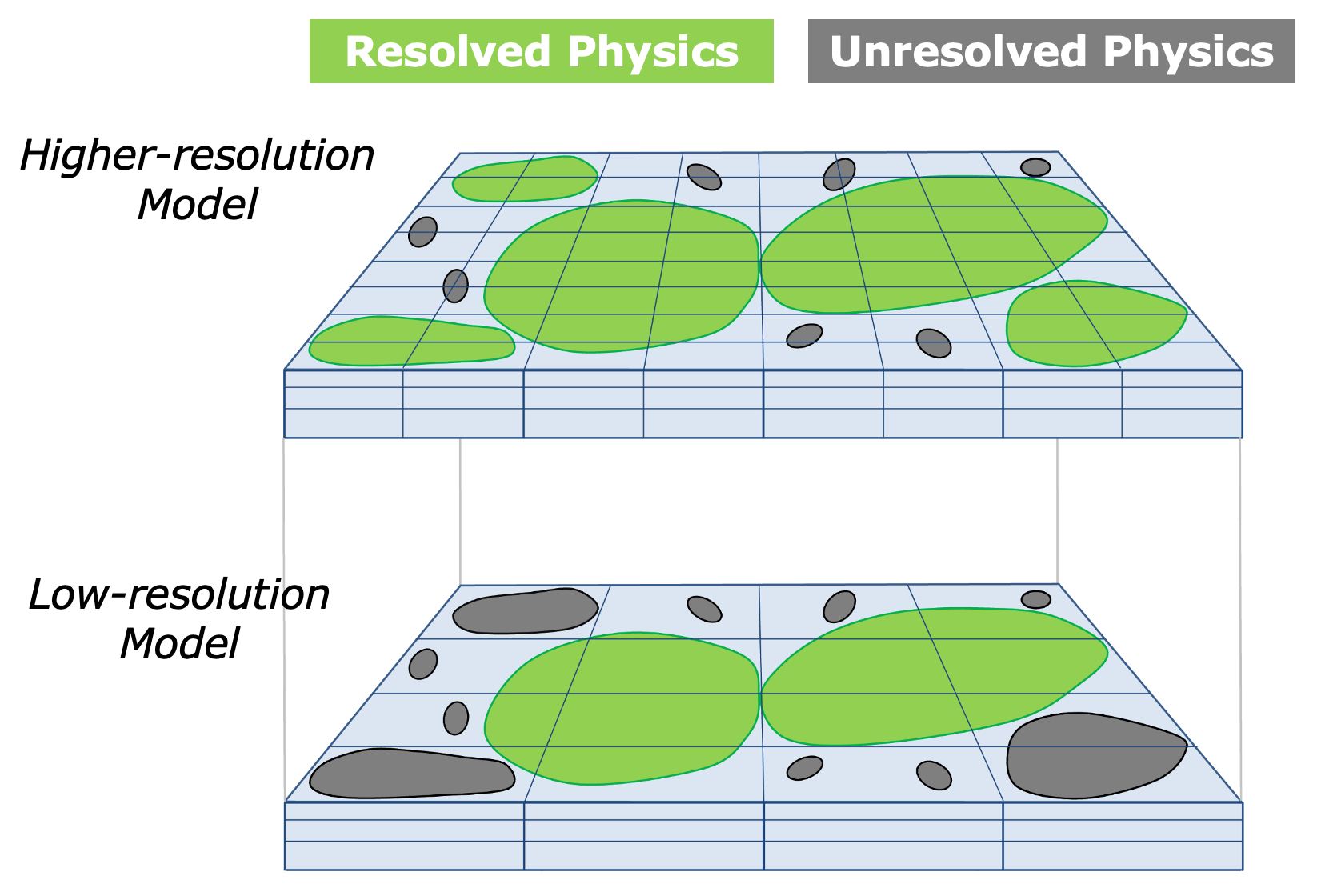 Resolution-dependent lateral mixing in nested downscaling
In NEMO, lateral mixing is defined through a combination of mixing velocity scale (U), a mixing length scale (L), and the selected lateral mixing operator, which determines whether mixing is applied through a Laplacian (Δ, second-order) or Bilaplacian (Δ², fourth-order) formulation.
SURF-NEMO automatically prepares these parameters for both the tracer lateral diffusion and the momentum lateral viscosity.
Automatic estimation of lateral mixing parameters
The automatic estimation is the default behaviour at both user levels: whenever the velocity scale \(U\) or the length scale \(L\) is not explicitly provided, SURF-NEMO reconstructs the lateral mixing setup at runtime from the selected parent ocean product and from the generated child grid. In the Base configuration this is always the case, since lateral mixing parameters are not exposed to the user; in the Expert configuration, the same procedure applies as long as the \(U\) and \(L\) fields are left unset.
The automatic estimation uses:
-
the parent-model lateral mixing coefficient;
-
the parent-model mixing operator;
-
the parent-model length scale;
-
the parent-model horizontal resolution;
-
the child-grid horizontal resolution;
-
the child-grid scale factors,
e1tande2t.
The child-grid length scale is taken as the maximum horizontal scale factor of the generated NEMO mesh:
This approach keeps the nested model numerically consistent with the parent configuration and removes the need for manual tuning, which — if done inappropriately — is a common source of degraded solutions in downscaling applications.
Resolution-based coefficient scaling
The starting point of the estimation is the scaling of the lateral mixing coefficient with grid resolution. SURF-NEMO derives the equivalent child-model coefficient from the corresponding parent-model value, with a scaling law that depends on the selected horizontal mixing operator:
-
for a Laplacian operator, the coefficient is scaled linearly with the horizontal grid-refinement ratio;
-
for a bi-Laplacian operator, the coefficient is scaled with the fourth power of the horizontal grid-refinement ratio.
As a practical resolution-based scaling estimate, the equivalent lateral mixing coefficient for the child model can be estimated from the parent-model value as:
where:
-
\(A_{\mathrm{parent}}\) is the parent-model viscosity or diffusivity coefficient;
-
\(\Delta x_{\mathrm{child}}\) is the nested-grid spacing;
-
\(\Delta x_{\mathrm{parent}}\) is the parent-model grid spacing;
-
\(A_{\mathrm{child}}\) is the equivalent coefficient for the nested model;
-
\(n = 1\) for a Laplacian operator and \(n = 4\) for a Bilaplacian operator;
This scaling provides a first-order reduction of lateral mixing in the higher-resolution child model, consistent with the fact that part of the small-scale motions parameterized in the parent model is explicitly resolved on the finer grid.
Estimation procedure
Building on this scaling law, the lateral mixing parameters are reconstructed from the parent-product metadata and the child-grid geometry in three conceptual steps:
-
Operator conversion. If the parent and child operators differ, the parent coefficient \(A\) is first converted to the convention of the selected child operator.
-
Resolution-based scaling. The coefficient is rescaled to the child resolution through the grid-refinement ratio \(s = \Delta x_{\mathrm{child}} / \Delta x_{\mathrm{parent}}\), following the scaling law described above.
-
Inversion to a velocity scale. The scaled coefficient is expressed as the velocity scale that NEMO expects, using the child length scale \(L\) and the operator-dependent relation between \(A\), \(U\), and \(L\).
The resulting velocity scale is, for a Laplacian operator:
and for a Bilaplacian operator:
where: \(A_{\mathrm{parent}}\) is the parent-model lateral viscosity or diffusivity coefficient (in the child-operator convention); \(s = \Delta x_{\mathrm{child}} / \Delta x_{\mathrm{parent}}\) is the child-to-parent grid-resolution ratio; \(L_{\mathrm{child}}\) is the child-grid length scale; \(U_{\mathrm{child}}\) is the resulting velocity scale.
The numerical factors 2 and 12 follow directly from inverting the NEMO coefficient definitions \(A_{\mathrm{lap}} = \tfrac{1}{2} U L\) and \(A_{\mathrm{blp}} = \tfrac{1}{12} U L^{3}\), while the powers of \(s\) implement the resolution-based scaling of the coefficient itself.
Overriding the automatic estimation
Advanced users working in the Expert configuration may bypass the automatic estimation and define their own horizontal mixing setup, by selecting the lateral mixing operator and explicitly providing custom \(U\) and \(L\) values, from which the horizontal eddy viscosity and diffusivity are computed.
This flexibility is useful for sensitivity experiments, numerical tuning, or applications that must reproduce a specific NEMO reference configuration.
Warning
Custom lateral mixing coefficients should be chosen with care. Values that are too large may overdamp mesoscale and coastal dynamics, while values that are too small may allow grid-scale noise to accumulate and trigger numerical instabilities.
Example: derived coefficients for the CMEMS parent products
The tables below illustrate the outcome of the automatic estimation of the lateral mixing parameters for all CMEMS ocean products currently supported as parent models. In every case the child model uses a Laplacian, iso-neutral operator for tracers and a bi-Laplacian, horizontal-geopotential operator for momentum, so an operator conversion (step 1) is required whenever the parent convention differs.
Tracer lateral diffusion (child operator: Laplacian, iso-neutral)
| Parent product (CMEMS) | Parent operator / coefficient |
Grid-ratio | \(L_{\mathrm{child}}\) | \(A^{lT}_{\mathrm{child}}\) | \(U_{\mathrm{child}}\) |
|---|---|---|---|---|---|
| MEDSEA_MULTIYEAR_PHY_006_004 (1/24°, NEMO3.6) |
bi-Laplacian \(1.2 \times 10^{8}\,\mathrm{m^4/s}\) |
0.5 | ~2316.5 m | \(3.6\,\mathrm{m^2/s}\) | \(3.11 \times 10^{-3}\,\mathrm{m/s}\) |
| MEDSEA_ANALYSISFORECAST_PHY_006_013 (1/24°, NEMO4.2) |
bi-Laplacian \(1.2 \times 10^{8}\,\mathrm{m^4/s}\) |
0.5 | ~2316.5 m | \(3.6\,\mathrm{m^2/s}\) | \(3.11 \times 10^{-3}\,\mathrm{m/s}\) |
| BLKSEA_MULTIYEAR_PHY_007_004 (1/40°, NEMO4.2) |
Laplacian \(13.9\,\mathrm{m^2/s}\) |
0.5 | ~1390 m | \(6.95\,\mathrm{m^2/s}\) | \(1.0 \times 10^{-2}\,\mathrm{m/s}\) |
| BLKSEA_ANALYSISFORECAST_PHY_007_001 (1/40°, NEMO4.2) |
Laplacian \(13.9\,\mathrm{m^2/s}\) |
0.5 | ~1390 m | \(6.95\,\mathrm{m^2/s}\) | \(1.0 \times 10^{-2}\,\mathrm{m/s}\) |
| GLOBAL_ANALYSISFORECAST_PHY_001_024 (1/12°, NEMO3.6) |
Laplacian \(100\,\mathrm{m^2/s}\) |
0.25 | ~2316.6 m | \(25\,\mathrm{m^2/s}\) | \(2.158 \times 10^{-2}\,\mathrm{m/s}\) |
| GLOBAL_MULTIYEAR_PHY_001_030 (1/12°, NEMO3.6) |
Laplacian \(100\,\mathrm{m^2/s}\) |
0.25 | ~2316.6 m | \(25\,\mathrm{m^2/s}\) | \(2.158 \times 10^{-2}\,\mathrm{m/s}\) |
Momentum lateral viscosity (child operator: bi-Laplacian, horizontal geopotential)
| Parent product (CMEMS) | Parent operator / coefficient |
Grid-ratio | \(L_{\mathrm{child}}\) | \(A^{lm}_{\mathrm{child}}\) | \(U_{\mathrm{child}}\) |
|---|---|---|---|---|---|
| MEDSEA_MULTIYEAR_PHY_006_004 (1/24°, NEMO3.6) |
bi-Laplacian \(2.0 \times 10^{8}\,\mathrm{m^4/s}\) |
0.5 | ~2316.5 m | \(1.25 \times 10^{7}\,\mathrm{m^4/s}\) | \(1.21 \times 10^{-2}\,\mathrm{m/s}\) |
| MEDSEA_ANALYSISFORECAST_PHY_006_013 (1/24°, NEMO4.2) |
bi-Laplacian \(2.0 \times 10^{8}\,\mathrm{m^4/s}\) |
0.5 | ~2316.5 m | \(1.25 \times 10^{7}\,\mathrm{m^4/s}\) | \(1.21 \times 10^{-2}\,\mathrm{m/s}\) |
| BLKSEA_MULTIYEAR_PHY_007_004 (1/40°, NEMO4.2) |
bi-Laplacian \(8.95 \times 10^{7}\,\mathrm{m^4/s}\) |
0.5 | ~1390 m | \(5.59 \times 10^{6}\,\mathrm{m^4/s}\) | \(2.5 \times 10^{-2}\,\mathrm{m/s}\) |
| BLKSEA_ANALYSISFORECAST_PHY_007_001 (1/40°, NEMO4.2) |
bi-Laplacian \(8.95 \times 10^{7}\,\mathrm{m^4/s}\) |
0.5 | ~1390 m | \(5.59 \times 10^{6}\,\mathrm{m^4/s}\) | \(2.5 \times 10^{-2}\,\mathrm{m/s}\) |
| GLOBAL_ANALYSISFORECAST_PHY_001_024 (1/12°, NEMO3.6) |
bi-Laplacian \(2.0 \times 10^{10}\,\mathrm{m^4/s}\) |
0.25 | ~2316.6 m | \(7.81 \times 10^{7}\,\mathrm{m^4/s}\) | \(7.540 \times 10^{-2}\,\mathrm{m/s}\) |
| GLOBAL_MULTIYEAR_PHY_001_030 (1/12°, NEMO3.6) |
bi-Laplacian \(2.0 \times 10^{10}\,\mathrm{m^4/s}\) |
0.25 | ~2316.6 m | \(7.81 \times 10^{7}\,\mathrm{m^4/s}\) | \(7.540 \times 10^{-2}\,\mathrm{m/s}\) |
Note
Coefficients are reported as magnitudes: NEMO namelists express bi-Laplacian coefficients as negative values (e.g. \(A^{lm} = -2 \times 10^{10}\,\mathrm{m^4/s}\) for the GLOBAL products), but only the magnitude enters the estimation. The child length scale is \(L_{\mathrm{child}} = \max(e1t, e2t)\) of the generated mesh; the values below use the representative basin-scale resolutions.